
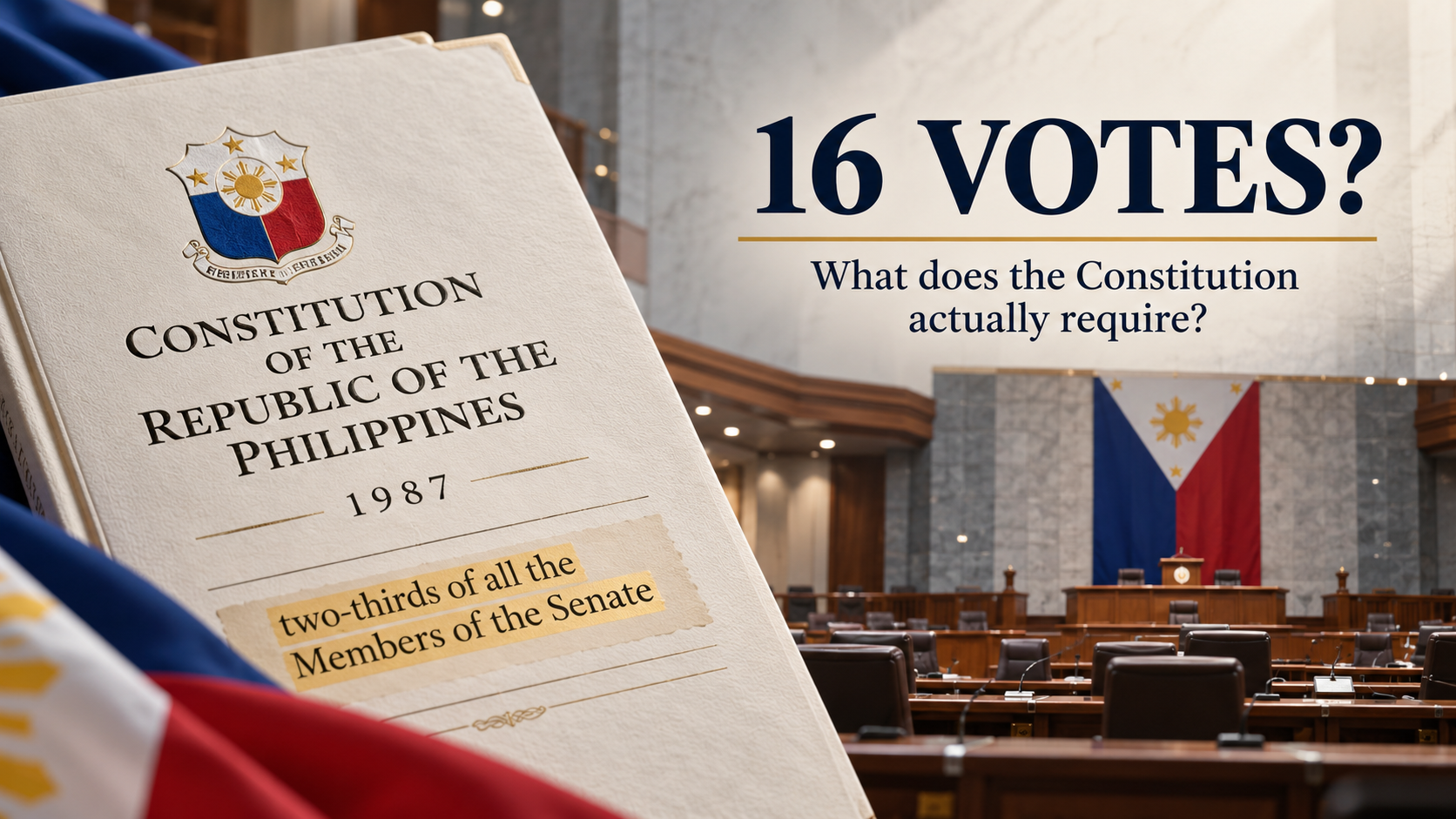
The Sara Duterte impeachment trial has raised a constitutional dispute over how many Senate votes are required for conviction. The Senate impeachment court has changed how it calculates the two-thirds threshold, bringing renewed attention to the Constitution’s phrase “all the Members of the Senate.”
Until recently, the working threshold was straightforward: 16 votes out of 24 senators.
That number comes from Article XI, Section 3(6) of the 1987 Constitution, which states:
“No person shall be convicted without the concurrence of two-thirds of all the Members of the Senate.”
With 24 members of the Senate, two-thirds is 16. Lawphil
But on September 23, 2026, the Senate sitting as an impeachment court voted 13–1 to overturn its earlier interpretation requiring a fixed 16 votes for conviction. Six senator-judges did not participate in the vote. Philippine News Agency
The new rule does not formally replace the constitutional requirement of “two-thirds.”
Instead, it changes who counts as part of “all the Members of the Senate.”
And that is where the constitutional controversy begins.
What did the Senate change?
Under the new interpretation, senators who are not legally or factually capable of participating when judgment is rendered may be excluded from the number used to calculate the two-thirds requirement.
The Senate ruling identified circumstances including senators who are detained or suspended, legally prevented from exercising their functions, medically or physically incapacitated, outside the Senate’s coercive reach, or similarly unable to participate. Philippine News Agency
That can make a significant difference.
If all 24 senators are counted:
24 × 2/3 = 16 votes needed to convict.
But if only 20 senators are considered capable of participating:
20 × 2/3 = 13.33, meaning at least 14 votes would be required.
International and Philippine reports therefore described the practical effect of the ruling as lowering the number of votes that may ultimately be required for conviction. CNA
What exactly does the Constitution say?
This is the crucial part.
Article XI, Section 3(6) does not say:
“two-thirds of the senators present.”
It does not say:
“two-thirds of the senators voting.”
And it does not expressly say:
“two-thirds of the senators capable of participating.”
The Constitution says:
“two-thirds of all the Members of the Senate.” Lawphil
That wording is now at the center of the legal dispute.
Those opposing the Senate ruling argue that the phrase “all the Members” refers to the Senate’s full constitutional membership and therefore means 16 votes in a 24-member chamber.
Several minority senator-judges made that argument when they declined to support the new interpretation, saying the impeachment court could not effectively alter a requirement written into the Constitution. ABS-CBN
What is the argument for changing the calculation?
The other side argues that the constitutional two-thirds requirement remains untouched.
Senate President Sherwin Gatchalian and Senator-Judge Risa Hontiveros said after the ruling that the Senate had not reduced the two-thirds standard. According to their position, the dispute concerns only which senators can properly be included in the voting base when some are legally or factually unable to participate. Philippine News Agency
House prosecutors have also argued that including senators who cannot participate could effectively produce what they describe as an “acquittal by default.”
Their argument is that someone who cannot hear the evidence, deliberate or cast a vote should not automatically function as a vote against conviction simply because that person occupies a Senate seat. GMA Network
So the competing interpretations can be reduced to one question:
What does “all the Members of the Senate” mean?
Interpretation 1:
All 24 Senate seats count. Therefore, conviction always requires 16 votes.
Interpretation 2:
Only senators legally and factually capable of participating in the impeachment judgment count, and two-thirds is calculated from that number.
The Constitution provides the phrase.
The dispute is over how that phrase should be applied when senators cannot participate.
The Supreme Court has now been asked to intervene
The controversy has already moved beyond the Senate.
Former Executive Secretary Vic Rodriguez filed a petition with the Supreme Court seeking to nullify the September 23 ruling. Lawyer Ernesto Francisco Jr. subsequently filed another challenge. Both contend that the constitutional phrase “all the Members of the Senate” requires the full Senate membership to be used when determining the conviction threshold. GMA Network
As of September 25, 2026, the Supreme Court has not issued a ruling resolving this particular constitutional question.
The Senate impeachment court is therefore continuing under its newly adopted interpretation because no temporary restraining order has stopped it. Philippine News Agency
Why this issue is bigger than Sara Duterte
This dispute should not be viewed only through the question of whether someone supports or opposes Vice President Sara Duterte.
The interpretation adopted today could affect how future impeachment courts understand the Constitution.
Imagine a future impeachment involving a completely different president, vice president, Supreme Court justice or constitutional officer.
If members who cannot participate can be removed from the denominator, the number of votes required for conviction could change depending on the circumstances of the Senate at the time.
That is why the legal definition of “all the Members of the Senate” matters beyond a single politician.
The Constitution deliberately requires a supermajority for conviction. The present dispute is about determining the membership base from which that supermajority must be calculated.
So, is the new threshold unconstitutional?
At this point, the accurate answer is:
That is now a contested constitutional question, not yet a settled judicial conclusion.
There is a strong textual argument being advanced by opponents of the Senate ruling: the Constitution expressly uses the words “all the Members of the Senate,” rather than members present or members participating. Lawphil
The Senate majority, however, argues that it is still applying the constitutionally required two-thirds vote and is only determining who legally belongs in the denominator for purposes of the judgment. Philippine News Agency
The Supreme Court has now been asked to decide whether that interpretation is permissible.
Until the Court rules, PHExpat should distinguish between two things:
What the Constitution literally says, and how the Senate impeachment court has chosen to interpret those words.
That distinction is more important than political allegiance.
PHExpat Bottom Line
The Constitution requires the concurrence of two-thirds of “all the Members of the Senate” before an impeached official may be convicted.
The original interpretation required 16 of 24 senators.
The Senate impeachment court has now ruled that senators legally or factually incapable of participating may be excluded when calculating the two-thirds requirement.
Critics argue that this conflicts with the Constitution’s explicit use of the word “all.” Supporters of the ruling argue that the two-thirds requirement itself remains unchanged and that the Senate is merely defining the proper voting base.
The Supreme Court has now been asked to determine which interpretation is constitutionally valid. GMA Network