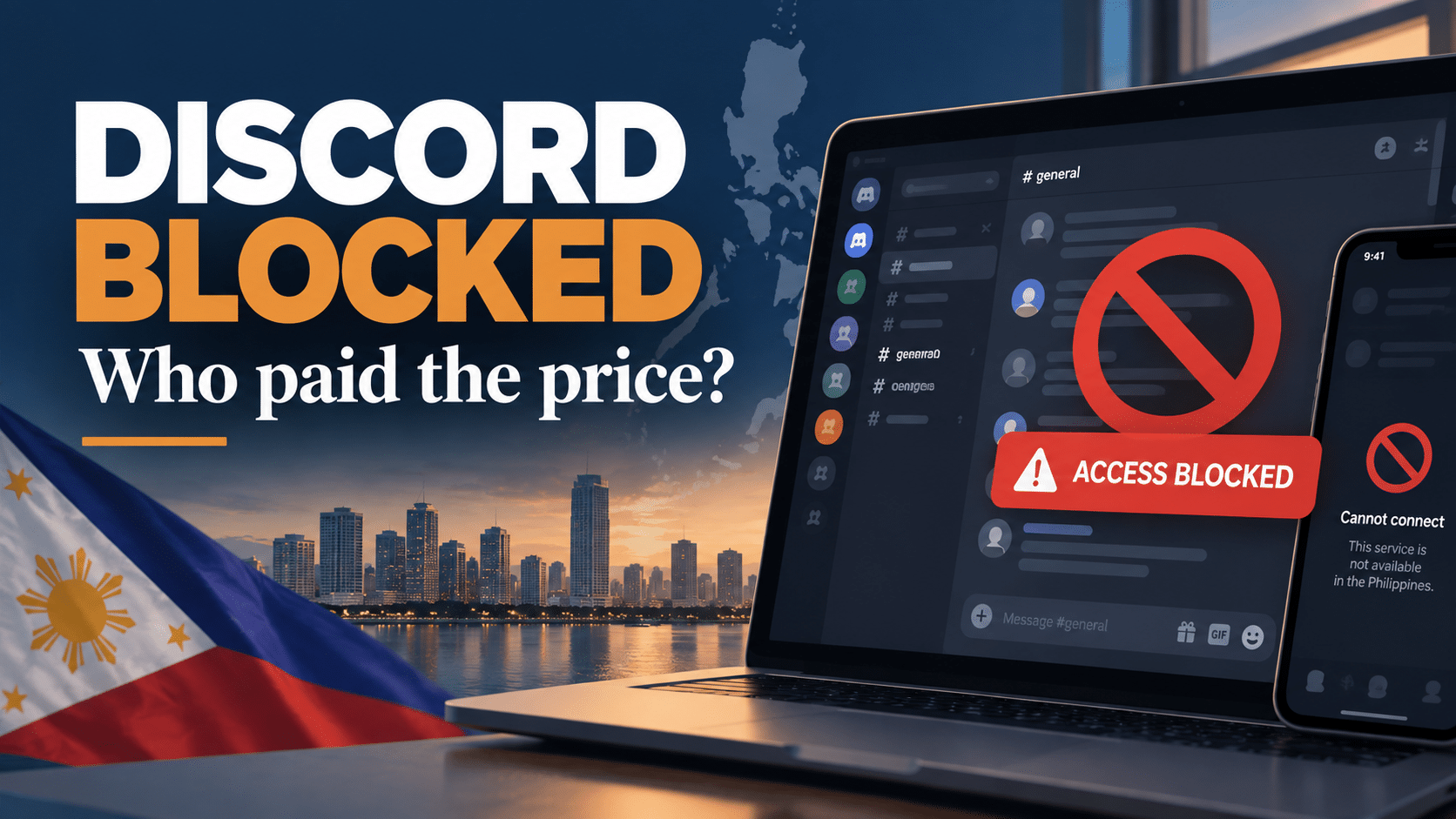
The Philippines Discord ban lasted only hours, but the episode exposed a much bigger argument about how the government should respond to online dangers without disrupting thousands of legitimate users.
On September 23, 2026, access to Discord began disappearing on some Philippine internet networks after authorities moved to block the platform. By the following afternoon, the government had reversed the decision after talks with Discord.
In between came confusion, anger and a basic question from Filipino users:
Was blocking an entire communications platform really the best way to solve the problem?
The government says the temporary restriction helped secure stronger cooperation from Discord on child safety.
Critics say the approach was too broad, affected people who had nothing to do with the alleged harms, and raised questions about the government’s authority to block an online platform in the first place. Philippine News Agency
Why did the government move against Discord?
The controversy began with concerns about online child safety.
On September 22, the Cybercrime Investigation and Coordinating Center, or CICC, gave Discord and Reddit 24 hours to establish a Philippine presence so authorities would have a clearer channel for dealing with threats and illegal activity on their platforms.
The move followed concerns about online communities allegedly connected to recent school shootings and other risks involving minors. The National Privacy Commission was separately examining Discord, Reddit, Meta and Roblox over compliance with Philippine data-protection requirements. Philippine News Agency
CICC Executive Director Renato Paraiso said the government was not asking platforms to police the internet on its behalf. The agency wanted companies to be reachable and responsive when activity on their services created risks for Filipinos. Philippine News Agency
That objective — making global platforms more accountable to Philippine authorities — was not necessarily what caused the backlash.
The controversy was how the government chose to enforce it.
Access started disappearing
After the deadline, the CICC sought the blocking of Discord.
Users on several Philippine networks subsequently reported that Discord had become inaccessible or partially unusable.
For some people, that meant losing access to a gaming community.
For others, Discord was part of their livelihood.
The platform is used by remote employees, freelancers, software developers, artists, gaming companies and online community managers to communicate with employers and clients. Filipino workers interviewed during the block described Discord as an essential workplace tool rather than simply a social-media service. BitPinas
That distinction fueled much of the anger.
Blocking Discord did not affect only people involved in suspicious communities. It also affected legitimate users across an entire platform.
“How will we work?”
Reaction online was swift.
Filipino users questioned why workers, students and businesses should bear the consequences of misconduct by some users of the platform.
Content creator Dino Roman raised concerns about Philippine-based workers whose professional communication depended on Discord. Other creators said the platform was important for game development, creative work, education and small businesses. Interaksyon
Technology-focused reporting documented similar frustration among remote workers and digital professionals whose clients and communities operate through Discord. BitPinas
The criticism was essentially about collateral damage.
Few of the critics disputed that protecting children online is important.
The disagreement was over whether restricting access to the entire service was a proportionate response.
Could bad actors simply move elsewhere?
Another criticism concerned effectiveness.
Blocking access to one platform does not necessarily remove the underlying threat.
People seeking to commit crimes or spread dangerous material can potentially migrate to another service. Meanwhile, ordinary users who follow the rules may experience the greatest immediate disruption.
Some technology commentators also noted that technically knowledgeable users could circumvent an ISP-level restriction, raising questions about whether a blanket block would meaningfully stop determined offenders. TECH WATCH PH
That creates an uncomfortable policy problem.
If dangerous actors can evade or migrate away from a block while legitimate workers lose access to their communication tools, then authorities need to explain what the restriction is expected to accomplish.
The legal question
The blocking also produced questions about government authority.
Former DICT Undersecretary Jeffrey Ian Dy publicly argued that blocking Discord without a court order was unconstitutional. He cited the Supreme Court’s 2014 decision in Disini v. Secretary of Justice, which struck down Section 19 of the Cybercrime Prevention Act.
That section would have allowed the Department of Justice to restrict or block computer data based on its own prima facie finding that the material violated the cybercrime law.
The Supreme Court held that the provision was unconstitutional because it allowed blocking without judicial intervention and violated constitutional protections involving freedom of expression and unreasonable searches and seizures. eLibrary
However, that does not automatically establish that the 2026 Discord order itself was unconstitutional.
The specific legal authority used by the agencies, the mechanism of the block and how existing statutes apply would have to be examined before reaching that conclusion.
What can be said is that the Disini decision gave critics a serious precedent to point to when questioning unilateral government blocking of online content or services.
Then the government reversed the ban
The restriction did not last long.
On September 24, after talks between Philippine officials and Discord representatives, the CICC announced that it was ordering the block lifted.
According to the government, Discord agreed to improve cooperation with Philippine authorities, including a faster channel for identifying threats and responding to online child-safety concerns. News 5 | Always On
DICT Secretary Henry Aguda described the negotiations as successful.
The government later characterized the temporary restrictions as having helped secure operational commitments from Discord and Reddit on illegal content and the protection of minors. ABS-CBN
So from the government’s perspective, the pressure worked.
That deserves to be included in any fair assessment of what happened.
The CICC apologized to affected users
Paraiso also apologized to users inconvenienced by the temporary ban.
He acknowledged that people had been affected during the hours that Discord was unavailable. News 5 | Always On
Aguda maintained that the restriction had one purpose: protecting children.
That explanation addresses the government’s intention.
It does not completely answer the questions about execution.
A successful pressure tactic — or an unnecessarily disruptive one?
Two interpretations of the episode can coexist.
The government can argue that threatening and temporarily restricting access forced a major international platform to respond quickly and provide commitments that Philippine authorities had been seeking.
Critics can reasonably ask whether those negotiations could have occurred before disrupting access for legitimate users.
Those are different questions.
One concerns whether the government eventually achieved something.
The other concerns whether the process used to achieve it was proportionate, legally sound and adequately planned.
The restriction was imposed and withdrawn within roughly a day. Users were disrupted, the responsible agency apologized, and negotiations produced commitments shortly afterward. News 5 | Always On
That rapid sequence is precisely why the controversy deserves scrutiny.
What the Discord episode should teach government
Online child exploitation, grooming, violent extremism and threats against minors are serious problems.
Government cannot simply ignore them because enforcement is difficult.
But digital platforms have become infrastructure for ordinary life.
People work through them.
Students collaborate through them.
Businesses communicate with customers through them.
Communities depend on them.
That means restricting access to an entire platform is no longer comparable to closing an obscure website.
The economic and social effects can spread immediately to people who have committed no wrongdoing.
The Discord controversy therefore presents a broader question for Philippine digital policy:
When government confronts online harm, how can it target the harmful activity without treating millions of legitimate users as collateral damage?
That question will matter long after Discord is accessible again.
PHExpat Bottom Line
The government had a legitimate public-safety concern: protecting children and ensuring that major online platforms cooperate with Philippine authorities.
Discord users also had legitimate concerns.
The restriction disrupted workers and communities, could potentially be circumvented by determined users, and prompted legal questions about the government’s authority to impose a platform-wide block. TECH WATCH PH
The government says the temporary action succeeded because Discord subsequently committed to stronger cooperation.
Critics argue that legitimate users should never have been caught in the middle.
The ban may be over.
The policy question it exposed is not.